
Soft launch vs hard launch: a staged plan with no QA team
Soft launch vs hard launch explained for software, how a beta differs from both, and a staged launch plan for a founder shipping alone with no QA team.
 By Bhavana, QA Engineer
What soft launch vs hard launch means for a software product
A soft launch is a release to a small, limited group of real users before you open the product to everyone. A hard launch is the opposite: you open signups, publish the announcement, and send traffic all at once, on a fixed date. The soft launch definition that matters for a software team is about exposure, not features. The product is the same build either way. What changes is how many people can reach it and how loudly you tell them it exists.
Founders shipping with AI coding tools often skip straight to a hard launch because there is no QA team to tell them otherwise. That is backwards. A soft launch costs you a few days and gives you a chance to find the bugs that only show up with real accounts, real data, and real traffic patterns, before a public announcement makes those bugs visible to everyone at once.
This article is about software products only. It does not cover the dating or relationship use of “soft launch.”
Soft launch meaning in practice: what it catches
What does soft launch mean day to day. It means you turn the product on for a defined, small audience and watch what happens before you widen access. In practice this looks like:
- Inviting 20 to 200 users through a waitlist, a personal network, or a single channel like a newsletter or community.
- Leaving the signup page up but not promoting it anywhere else.
- Watching error logs, support messages, and usage data closely for a set number of days.
- Fixing what breaks before inviting the next wave.
A soft launch catches the bugs that depend on real accounts: payment edge cases, email deliverability, onboarding steps that confuse people who were not in the room when you built them, and load patterns you did not simulate. It will not catch everything. It catches what a small, real audience does differently than you expected.
How a beta differs from a soft launch and a hard launch
A beta is not the same as a soft launch, even though people use the words loosely. The difference is about purpose and duration, not size.
A beta is a defined testing phase with a stated purpose: you are asking a group of users to try the product and tell you what is broken or missing, often in exchange for early access or a discount. Users know they are in a beta. They expect rough edges and they expect to give feedback. A beta can run for weeks or months and the product can change shape during it.
A soft launch is not a testing phase. It is the first real release, run quietly. Users in a soft launch do not know they are early, and you are not asking them for feedback as the main point. You are shipping the real product to a smaller audience first, specifically to catch what breaks before a hard launch.
A hard launch is the public release moment. Marketing goes out, signups open to everyone, and you stop treating the product as pre-release.
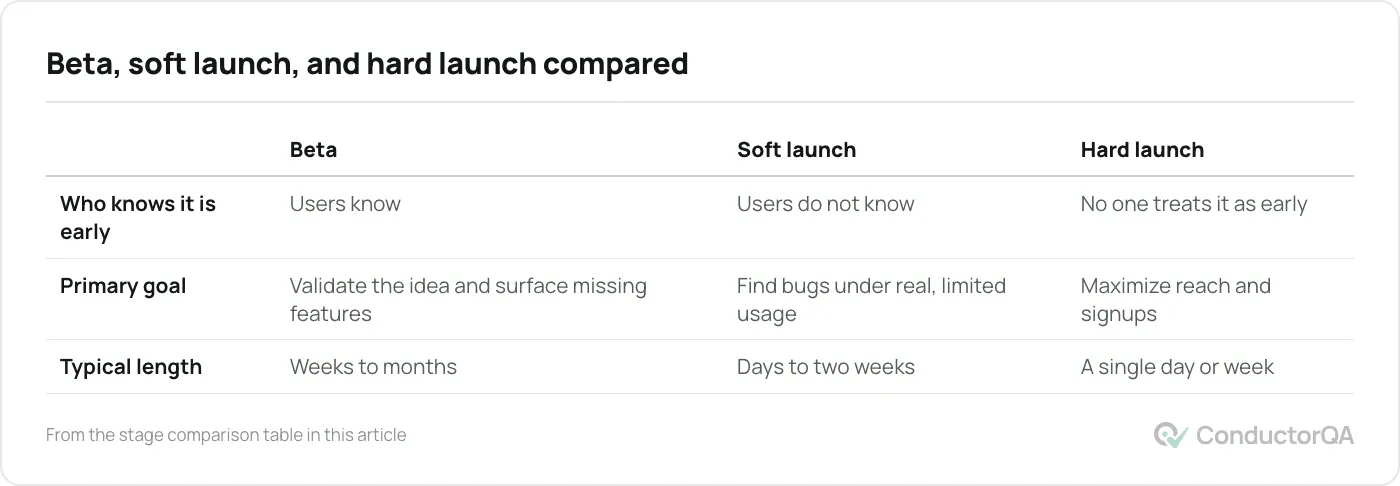
The order that works for most small teams is: beta, then soft launch, then hard launch. Beta tells you if the product is worth finishing. Soft launch tells you if the finished product survives contact with real usage. Hard launch is the day you stop holding anything back.
| Stage | Who knows it is early | Primary goal | Typical length |
|---|---|---|---|
| Beta | Users know | Validate the idea and surface missing features | Weeks to months |
| Soft launch | Users do not know | Find bugs under real, limited usage before wide exposure | Days to two weeks |
| Hard launch | No one treats it as early | Maximize reach and signups | A single day or week |
A staged launch plan for a founder with no QA team
If you are shipping alone, or with one or two other people and no dedicated QA engineer, you need a plan that does not depend on a team you do not have. Here is a staged plan that works with that constraint.
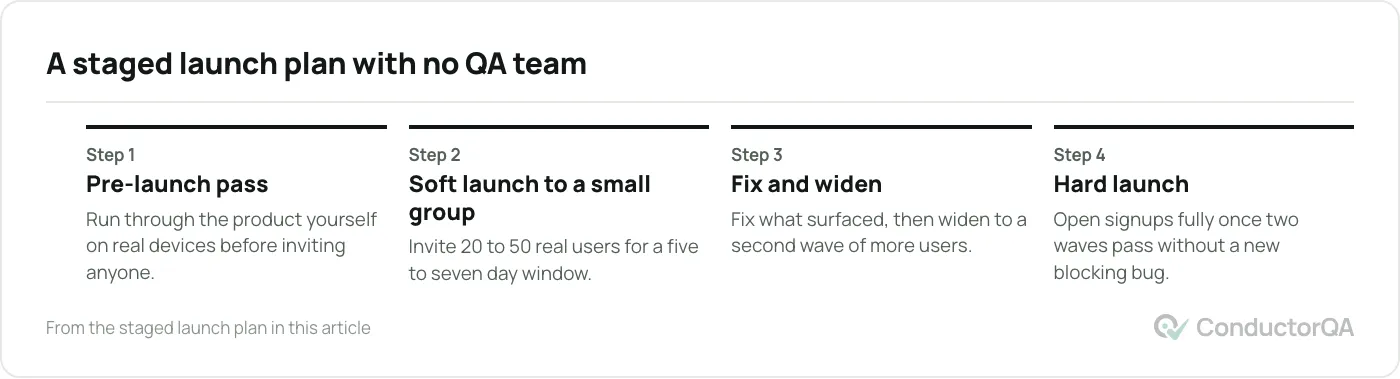
Stage 1: pre-launch pass (before any real users)
Before you invite anyone, run through the product yourself on the devices your users will actually use: a real phone, not just desktop Chrome at full width. Check the core flows end to end: signup, the main action the product exists for, and whatever involves money. A website launch checklist is a useful companion here, since it covers the broader set of items, from domain and analytics setup to legal pages, that a bug-focused pass does not. If you built with an AI coding tool like Lovable, Bolt, Cursor, or Replit, assume the generated code has not been tested on a real phone keyboard or a slow connection, because it usually has not.
A fixed-price audit from a QA team fits here if you want a second set of eyes before anyone else touches the product. It costs a fraction of a missed launch week and it does not require you to hire anyone permanently.
Stage 2: soft launch to a small group
Invite 20 to 50 real users. Pick people who will actually use the product, not just friends who will click around once. Tell them nothing special, just that the product is live. Set a specific window, five to seven days is typical for a small product, and commit to checking logs and support messages daily during it.
Track three things during this window:
- Errors in your logs, sorted by how many users hit each one.
- Where users drop out of your core flow, if you have any analytics at all.
- Every support question or complaint, even small ones, because they often point at the same root cause as a bug you have not noticed yet.
Stage 3: fix and widen
Fix what the soft launch surfaced, starting with anything that blocks a core flow or loses a user’s data. Then widen to a second wave, 100 to 500 users depending on your product, and repeat the same watch period. Most small products need one widening step before a hard launch. Some need two. If you do not have a QA engineer to help triage what you find, QA outsourcing for small teams covers the options and when each one makes sense.
Stage 4: hard launch
Once two consecutive waves pass without a new blocking bug, you have a reasonable basis for a hard launch. Open signups fully, publish your announcement, and treat the product as generally available. Keep watching logs closely for the first 48 hours, because a hard launch brings traffic patterns a soft launch never fully reproduces.
Where ConductorQA fits
A soft launch finds bugs through real usage, which takes days and only surfaces what that particular group of users happens to do. A pre-launch audit finds bugs by deliberately testing every route before any real user sees them, which takes 48 hours and does not depend on who you happened to invite. Most founders use both: an audit before the soft launch starts, and the soft launch itself as a second, real-world check. If you want that first pass before you invite anyone, see the pre-launch QA audit.
Frequently asked questions
What does soft launch mean versus a regular launch?
A soft launch is a release to a small, limited audience, done quietly without a public announcement. A regular, or hard, launch opens the product to everyone at once with marketing and public signups. The product itself can be identical. The difference is who can reach it and how much attention you draw to it.
What is a soft launch used for if the product is already built?
It is used to find the bugs and rough edges that only appear under real usage, such as payment edge cases, confusing onboarding steps, or load issues, before a wider audience sees them. It limits the damage of anything you missed to a small group instead of your whole market.
How long should a soft launch run before a hard launch?
Most small software products run a soft launch for five to seven days per wave, long enough to see real usage patterns but not so long that momentum stalls. Teams with no QA team often need two waves, each with a fix cycle in between, before a hard launch.
Is a beta the same as a soft launch?
No. A beta is a stated testing phase where users know the product is unfinished and are often asked for feedback directly. A soft launch is the first release of the finished product, run quietly to a smaller audience, without telling users they are early.