
QA outsourcing for small teams: options from $0 to $8,000/mo
QA outsourcing compared: freelance testers, offshore firms, crowdtesting, managed QA, and fixed-price audits, on cost, management time, and what you get back.
 By Arun, QA Lead
What qa outsourcing actually means for a small team
Qa outsourcing is the practice of paying an outside person or company to test your software instead of hiring a quality assurance engineer. For a small team, the decision usually comes down to five options, and each one trades cost against management time in a different way.
Most founders we talk to reach this decision at the same moment: a launch date is close, there is no one on the team whose job is testing, and the person who would normally check the app by hand is also the person writing the code. Outsourcing qa testing fills that gap. The question is which form of outsourcing qa fits a team with no QA hire and no time to manage one.
This article compares the five common paths: freelance testers, offshore QA firms, crowdtesting platforms, managed QA services, and fixed-price audits. We outline what each one costs, how much of your time it takes to run, how long it takes to get results, and what you actually receive at the end.
The five options compared
| Option | Typical cost | Management time | Turnaround | What you get back |
|---|---|---|---|---|
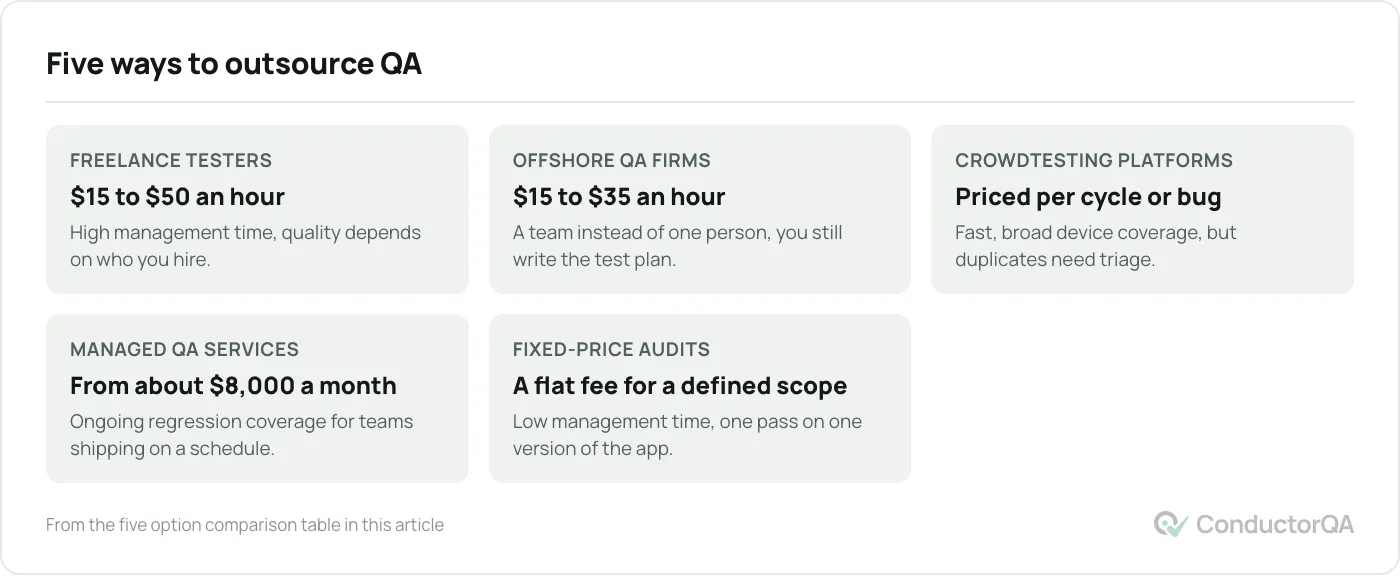
| Freelance testers (Upwork, Fiverr) | Typically $15 to $50 an hour, billed hourly | High: you write the brief, assign scope, review work daily | Depends on hours booked, often several days to weeks | Varies by tester. Usually a list of bugs in whatever format you ask for, quality depends heavily on who you hired |
| Offshore QA firms | Typically $15 to $35 an hour | Medium: you set the test plan and review a status call | Days to weeks depending on scope | A test cycle report, usually a spreadsheet or ticket export, quality depends on the firm and the plan you gave them |
| Crowdtesting platforms | Usually priced per test cycle or per bug, varies by platform | Medium to high: you write test cases or scenarios, triage incoming reports | Fast for broad device coverage, often 24 to 72 hours | A stream of bug reports from many testers on different devices, volume can be high, duplicates and false positives are common |
| Managed QA services | Subscription pricing, for example QA Wolf is publicly priced from about $8,000 a month | Low: the service runs tests on a schedule, you review results | Ongoing, continuous rather than one-off | Automated regression coverage plus a team that maintains the tests, suited to teams that already have a product in steady release cycles |
| Fixed-price audits | A flat fee set in advance for a defined scope, for example a set number of routes | Low: you send a URL and a start time, no hourly tracking | Typically 24 to 48 hours for a defined scope | A single bug report with severity ranking, reproduction steps, and a fix order, scoped to one app at one point in time |
A few things worth noting before you pick a column.
Freelance testers are the cheapest entry point and the widest range in quality. You are hiring an individual, not a process, so the brief you write and the person you pick matter more than the platform. If you have never managed a tester before, expect to spend real time writing the scope, answering their questions, and checking their work against what you actually shipped.
Offshore QA firms behave more like a vendor relationship. You get a team instead of one person, which reduces the risk of one tester having an off week, but you are still the one writing the test plan unless you pay for that too. Hourly rates in the $15 to $35 range are common for offshore shops, though rates vary by country and by how senior the testers are.
Crowdtesting platforms trade management time for volume. You get many testers on many real devices at once, which is useful for device and browser coverage that would be expensive to replicate in house. The tradeoff is triage: a crowd of testers produces a crowd of reports, including duplicates, severity disagreements, and the occasional false positive. Someone on your side has to read all of it and decide what is real.
Managed QA services are built for teams that already ship on a regular cadence and need regression coverage that runs itself. QA Wolf is one example, publicly priced from about $8,000 a month. That price point assumes an ongoing relationship, not a one-time check before a single launch. For a team that ships once and wants a bug list before that one launch, a subscription service is usually more commitment than the problem calls for.
Fixed-price audits sit at the other end from freelancers: little oversight, no hourly tracking, and a report format that is defined in advance because the scope is fixed in advance. The tradeoff is that you get one pass on one version of the app, not ongoing coverage. For a pre-launch check, that tradeoff usually makes sense. For a product that is already live and changing weekly, it does not replace regression testing.
How to think about cost versus management time
In our experience, most teams underestimate the time cost of outsourcing qa testing and only budget for the dollar cost. A freelancer at $20 an hour looks cheap until you count the hours you spend writing the test plan, answering their questions, and re-checking their bug list against your own understanding of the app. That management time is real cost, even if it never appears on an invoice.
A useful question to ask before choosing: who is going to write the test plan. Our test plan template is a reasonable starting point if the answer is you. If the answer is “me,” your management time goes up no matter which option you pick. If the answer is “the vendor,” your dollar cost goes up instead, because writing a good test plan takes experience.
A second question: how many times will this run. A one-time pre-launch check and a recurring weekly regression pass are different problems, and the five options above are not equally suited to both. Crowdtesting and managed QA services lean toward ongoing use. Fixed-price audits and most freelance engagements lean toward a single pass.
When each option fits
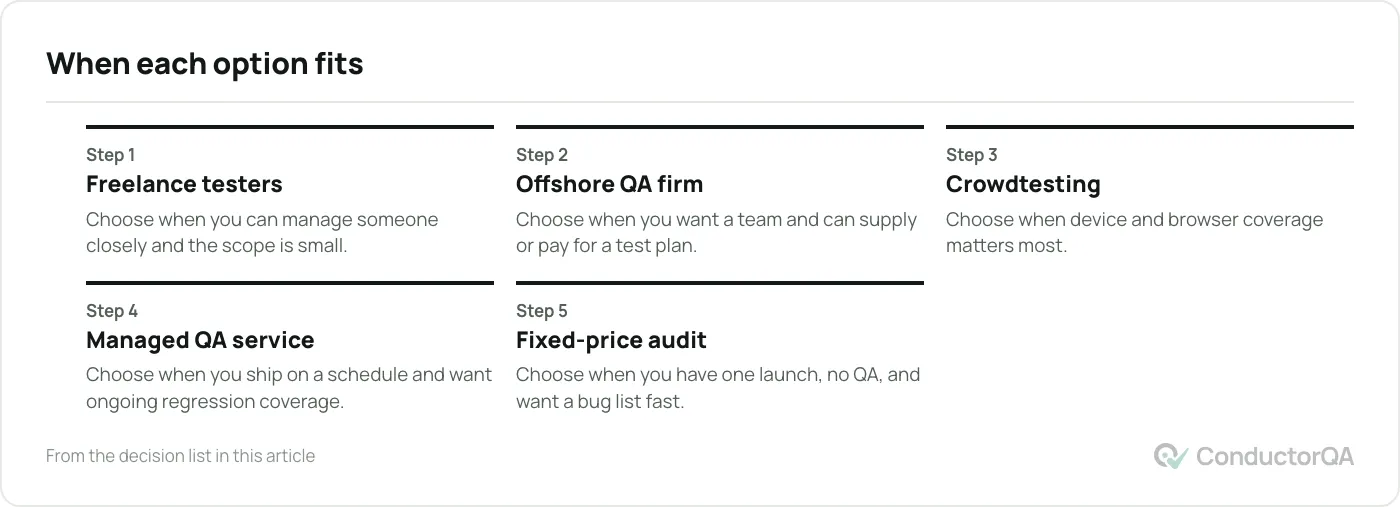
- Choose freelance testers when you have time to manage someone closely and the scope is small enough to brief in an afternoon.
- Choose an offshore QA firm when you want a team rather than one person, and you can write or pay for a test plan.
- Choose crowdtesting when device and browser coverage matters more than a tight, curated report.
- Choose a managed QA service when you already ship on a schedule and want regression coverage that runs without your involvement each time.
- Choose a fixed-price audit when you have one launch coming up, no internal QA, and want a bug list back in a defined window without managing the process.
Where ConductorQA fits
ConductorQA runs fixed-price pre-launch audits: send a URL, get a bug report back with severity rankings, reproduction steps, and a fix order, all tested by hand on real phones and browsers. It fits the case in the table above where you want a defined scope, a fixed cost, and no hourly management, ahead of a specific launch. If you are past that first launch and testing every week, pair an audit with one of the ongoing options above. See our software testing checklist for what to check before you outsource anything, and start with a qa audit if a launch date is the thing driving the decision.
Frequently asked questions
What does qa outsourcing cost for a small team?
It depends on the option. Freelance testers and offshore QA firms typically bill $15 to $50 an hour. Managed QA services use subscription pricing, often starting in the thousands of dollars a month. Fixed-price audits charge a flat fee for a defined scope, set before work starts.
Is outsourcing qa testing better than hiring a QA engineer?
For a small team with one launch or infrequent releases, outsourcing is usually cheaper and faster than hiring. A full-time QA engineer makes more sense once you are releasing often enough to need testing every week and the volume of work justifies a salary.
How do qa outsourcing companies differ from freelance testers?
A qa outsourcing company gives you a team and, often, a process, which reduces the risk of relying on one person. A freelancer is cheaper per hour but the quality and consistency depend entirely on that one person’s experience and availability.
Can I outsource qa testing for a single launch only?
Yes. Fixed-price audits and most freelance engagements are built for a single pass rather than an ongoing relationship. Managed QA services and crowdtesting platforms are generally a better fit once you are testing the same product repeatedly.